Lietuviškai
 English



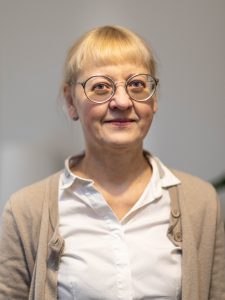
Psychologist – psychotherapist Dr. Klaudija Pauliukevičiūtė
SPECIALIZATION:
Mood disorders, interpersonal relationships, couple relationships.
Adult and senior counseling
Individual and group therapy
In Lithuanian, Russian
ABOUT
Don’t fix what’s not broken.
I am Dr. Klaudija Pauliukevičiūtė, a psychologist. I try to look at life positively, I have a sense of humor. Clients would also describe me as a determined, open, committed specialist. I value such qualities as wisdom, loyalty, and in my professional life – professionalism and responsibility.
My mission as a psychologist is to make the world at least a little bit better for all living beings. I see many different roles hidden behind the role of a psychologist – sometimes an expert, a friend, a mother, sometimes a citizen or a life skills trainer. No matter what role we bring to the fore, I am always a psychologist.
Working together
When communicating with clients, I create an environment based on safety, respect, cooperation, and sometimes – if it suits the clients and is valuable – immediacy. I try to help the client discover their expertise, encourage them to solve problems, change, and not “grow” illusions.
The consultation environment must be comfortable for the client, but not so much that it lulls them, after all, therapy is the work of both the client and the psychologist. A certain structure during the consultation is necessary, it provides clarity and security, however, every structure needs a place for jazz and fun. This process should not be all difficult.
I expect cooperation and respect from the client. I understand respect as a certain openness in the relationship with the psychologist. If the client directly talks about things that are not suitable or satisfactory during the consultation, the results will only be better.
Very rarely is one meeting enough for psychotherapy. We usually meet 6-10 times. The number of consultations is most closely related to the depth of the problem. If the problem or the events that caused it were very traumatic, if they lasted a long time, the therapy will most likely last longer. The frequency of meetings depends on the client’s well-being. If the experiences are very intense, several meetings per week may be necessary, but usually once a week is enough. If the condition is improving, the problems are being solved, “supportive” meetings once every two weeks or less are enough. Sometimes, to achieve results, the work of a team of specialists is required – a psychiatrist and/or other specialists.
The first consultation is unique for both the client and the psychologist. During it, we get to know each other and agree on the rules of further work. I delve into the concerns brought by the client, I try to understand what the client’s expectations are. And he/she also tries to assess how appropriate my tone, pace, insights, and elements of therapy are.
If it is agreed to continue working, to meet several more times, it is possible to define perspectives during the first consultation and, during subsequent consultations, to continue what was agreed upon at the beginning or to reveal something new. What does it look like: we sit and talk, sometimes I give homework that requires more or less effort, but always helps to understand myself better. Do I do my homework myself? Yes.
Why therapy?
People who want to start attending therapy are often afraid of what others will think of them, whether they will be able to express themselves clearly and achieve the desired changes. I would like to wish my future client to say everything they think, what they don’t like, what is not suitable, not to worry about the form – this is the only way to achieve mutual respect and trust. I also wish you to ask boldly, because silences eventually separate people, not bring them closer together.
You deserve the opportunity to feel good – to solve problems or learn to live with them, to acquire skills to work with them, to become more mature. This can be achieved in psychotherapy.
NATURE OF WORK
I have experience in both group and individual consultations. I can help with mood disorders, difficulties in interpersonal relationships or in a couple.
I rely on several theoretical directions in my work. I am most focused on the client’s strengths and needs. What methods I will apply depends on what the client says about himself/herself and the problem, what expectations he/she has regarding therapy, and what meanings he/she puts into different concepts.
EXPERIENCE
I have been working as a psychologist since 1993.
I worked at Kaunas Boarding School for the Visually Impaired, Kaunas Crisis Center, Šančiai Polyclinic Mental Health Center, AB “Kauno Grūdai”, and currently at “Romuvos Kliniko”.
I have experience in academic work. I have taught various psychology disciplines at Kaunas College, Klaipėda University (KU), Lithuanian University of Health Sciences (LSMU), I have taught various psychology courses, and during my studies I volunteered at the “Youth Line”.
My longest academic work experience is at Vytautas Magnus University (VMU), where I currently conduct several course seminars for psychology students.
I encourage you to start a journey towards internal changes, I invite you to book a consultation time.
ARTICLES
Žardeckaitė-Matulaitienė, Kristina; Pauliukevičiūtė, Klaudija. Effectiveness of smoking prevention program based on social influence approach in 6th grade. Kaliningrad: BFU im. И. Kanta, 2011. p. 93-107.
Pauliukevičiūtė, Klaudija ; Žardeckaitė-Matulaitienė, Kristina. The meaning of being ethical psychologist : second year’s psychology students’ perspective // Living responsibly : ethical issues in everyday life [electronic resource] / editor Jan Prothmann. Oxfordshire : Inter-disciplinary press, 2015. ISBN 9781848882508, p. 1-9.